The number that settles your tape test isn’t on the scale — it’s the body fat percentage the Army allows for someone your age and sex. Clear it and you’re done; go over and you’re flagged for the Army Body Composition Program (ABCP) until you’re back under.
Here are the full Army body fat standards, current under AR 600-9 for 2026, in the two charts that actually decide it.
The Army body fat standards chart, by age
The Army sets one body fat ceiling per age bracket, and it rises as you get older. Men and women are scored on separate scales. The figures here are the active-duty standard — the limit you stay under once you’re already serving.
| Age | Men (max %) | Women (max %) |
|---|---|---|
| 17–20 | 20% | 30% |
| 21–27 | 22% | 32% |
| 28–39 | 24% | 34% |
| 40 and older | 26% | 36% |
Two things are worth reading off the chart. The limit moves in four steps rather than sliding year by year, so turning 21 or 28 shifts your ceiling overnight. And the women’s column runs ten points above the men’s at every age — not a courtesy, but the higher level of essential fat the female body carries to function.
Want your own number against these limits? The calculator on the homepage scores you in seconds and, if you’re over, hands back the exact waist measurement that brings you under for your age.
Enlisting vs staying in: two different limits
Recruits get a little more room than serving soldiers, on the logic that initial training will tighten things up. For men the accession limit sits four points higher at every age; for women it matches the active-duty figure exactly.
| Age | Men enlisting (max %) | Women enlisting (max %) |
|---|---|---|
| 17–20 | 24% | 30% |
| 21–27 | 26% | 32% |
| 28–39 | 28% | 34% |
| 40 and older | 30% | 36% |
So a 22-year-old man can enlist at up to 26% but has to reach 22% to stay in once he’s serving. For a woman that age, the bar is 32% either way.
How the standard is applied: screening first, tape second
The body fat percentage isn’t the first thing the Army measures. There are two gates:
- Height and weight screening. Every check starts here. The Army keeps a standardized height/weight table; come in under the line for your height and you pass with no tape at all.
- The tape test. Only if you’re over the screening weight does the Army measure body fat, and only then do the percentages above come into play.
The order catches people out. A lifter can blow past the screening weight and still clear the tape easily, because muscle drives weight up without driving body fat up. The scale flags you; the tape clears you.
What changed in 2023 (and what didn’t)
Until June 2023 the Army used a multi-site tape method — neck and abdomen for men, neck, waist, and hip for women. Army Directive 2023-11 replaced all of it with a single measurement: abdominal circumference at the navel, read against your bodyweight.
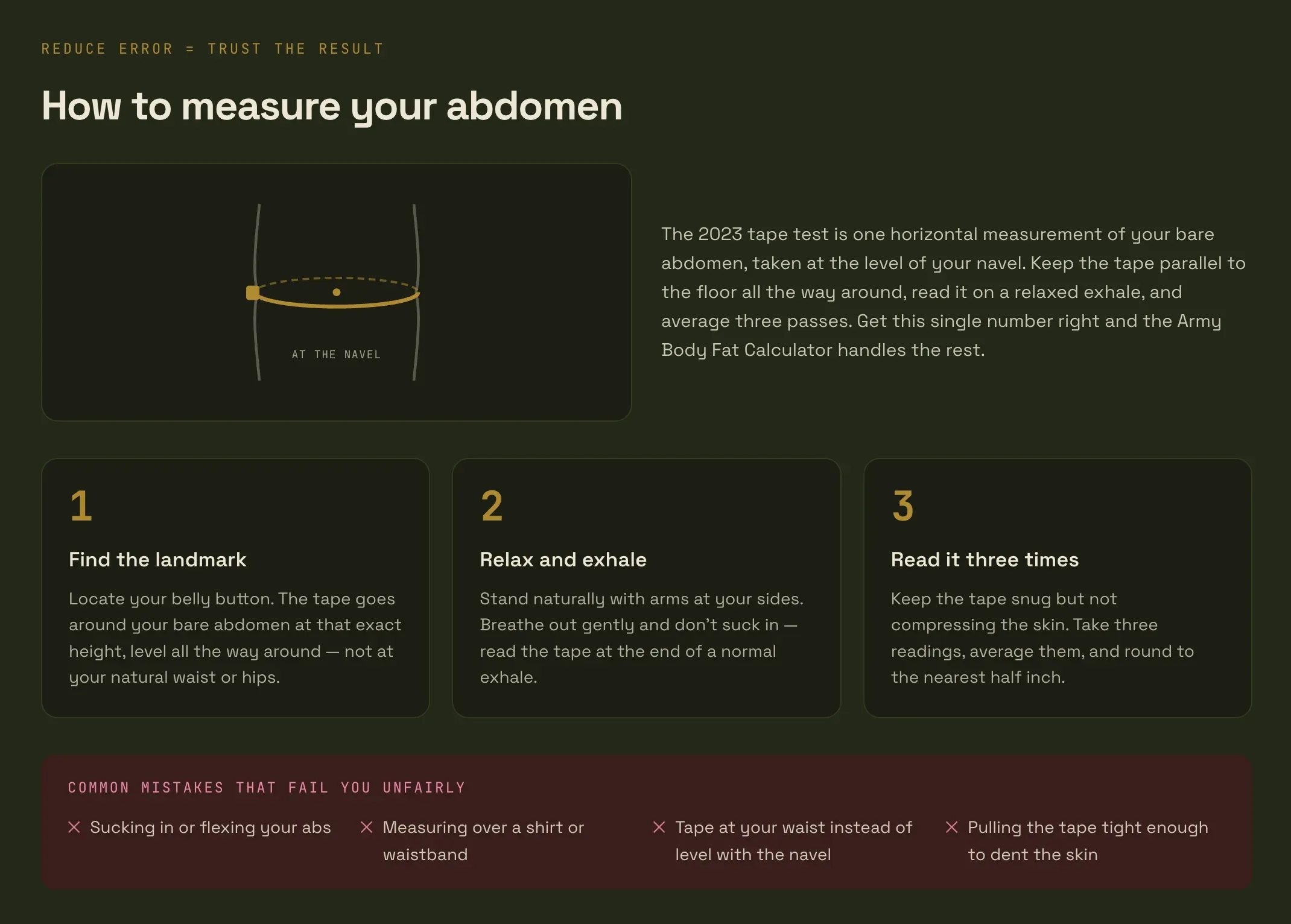
The percentages in the charts above didn’t move with that change, and they hold for 2026. What changed is how the number gets taken — one measurement instead of three, which leaves fewer places to make a mistake. The site’s measurement walkthrough shows exactly where the tape sits.
There’s also a way around the tape entirely: score high enough on the Army Fitness Test, with at least 80 points in each event, and you’re treated as meeting the standard even if you’re over the screening weight.
How your body fat percentage is calculated
The math behind the chart is a fixed formula. For men it reads:
Body fat % = −26.97 − (0.12 × weight in lb) + (1.99 × abdomen in inches)
Women run the same structure with their own coefficients. Take a tape reading at the navel, enter your weight, and compare the result to your age’s row in the chart. The calculator does this with the same rounding the official tables use, and it answers the part the raw formula can’t: the precise waist that would put you under, so you’re aiming at a target inch instead of guessing.
Here’s how that plays out. A 30-year-old man at 200 lb with a 37-inch abdomen comes out at 23% body fat — under the 24% ceiling for his bracket, but one point from trouble. Push the tape to 38 inches and the reading climbs to 25%, a fail. A woman the same age has more headroom, since her limit is 34%, yet the rule is identical: a couple of inches at the navel is what separates a pass from a flag. That margin is the thing a standards table alone can’t show you, and what the calculator’s target-waist readout is built for.
What women should know about the standard
Women’s limits sit ten points above men’s, but the method behind them is identical since 2023 — the same single abdominal measurement at the navel, the same weight pairing, the same age brackets. The old female method that wrapped neck, waist, and hip is retired.
Two points trip women up most often. The screening table comes first here too, so a tape test only happens if you’re over the height/weight line. And the limit genuinely does not tighten when you enlist: 30, 32, 34, and 36 percent across the four brackets — the same on enlistment day as at a retention check years later.
If your tape test comes back over
A failed tape isn’t the end of it. You can ask for a supplemental body fat assessment using a more accurate method — a DXA scan, an InBody analysis, or a Bod Pod — and where one is reasonably available, that result outranks the tape. Your commander or the installation fitness facility is the place to start.