There’s no shortage of tape-test “hacks” online: chug no water, suck in hard, hold your breath. They don’t work the way people think, and a couple of them hand you a worse number instead of a better one. Passing the Army tape test really comes down to two unglamorous things — knowing the exact number you need to hit, and actually getting there. Here’s how to do both.
First, find out how far off you actually are
Most people walk into the tape test guessing. Don’t. The calculator on the homepage takes your weight and abdominal measurement and gives you two numbers: your current body fat percentage, and the exact waist measurement that would put you under the limit for your age.
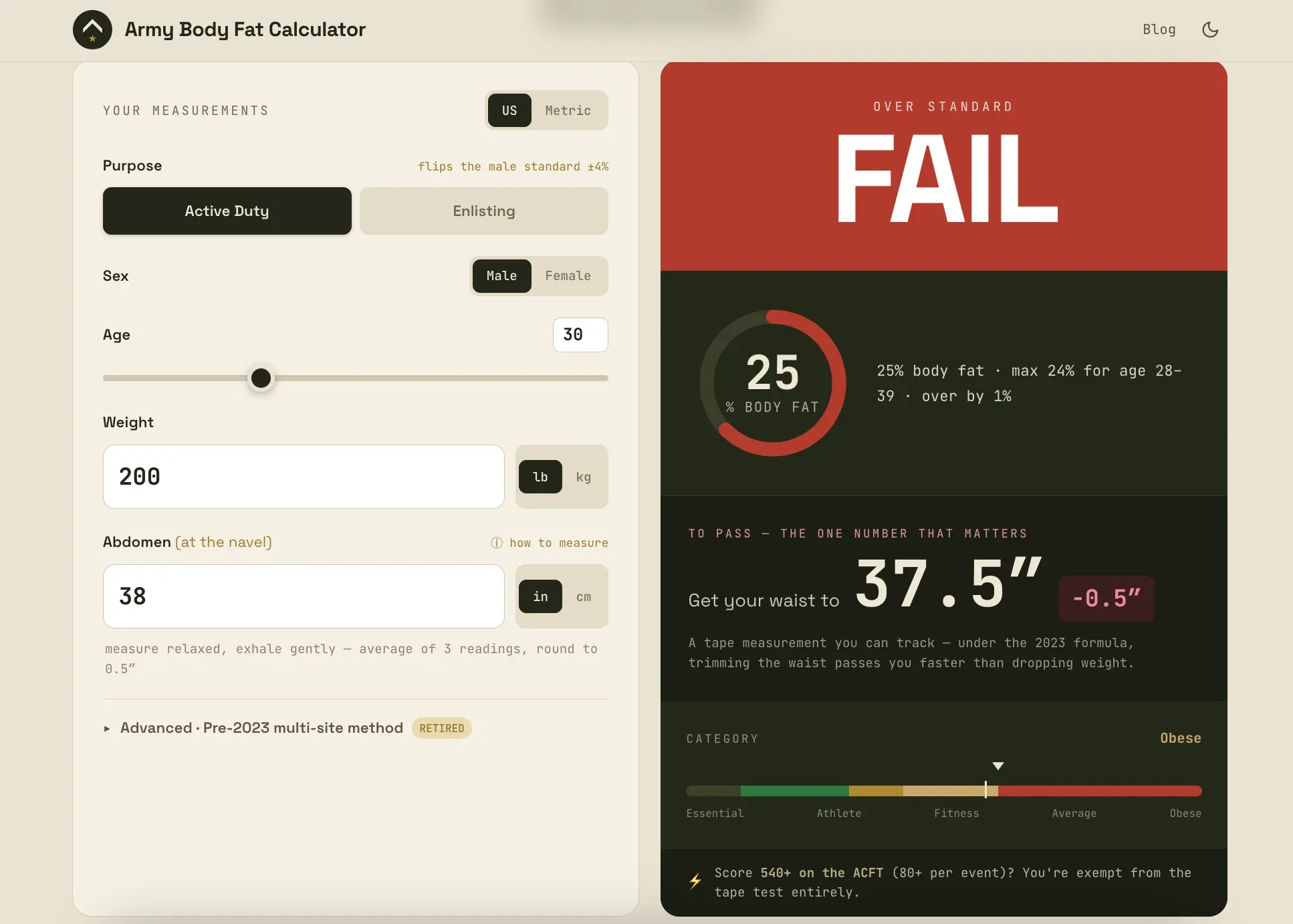
That second number is the whole game. If you’re taping at 39 inches and the calculator says 37 would pass you, you’re not chasing a vague “lose some weight” goal — you’re chasing two inches off your waist. (The standards chart has the full limit by age and sex if you want to see exactly where your line sits.)
Find the gap first. Everything below is about closing it.
Get the measurement right — half the “failures” aren’t fat
A lot of people fail the tape on a measurement taken wrong, not on actual body fat. The 2023 method is one wrap at the navel, level all the way around, read on a normal breath out. Simple, but easy to botch, and the mistakes all push your number up:
- Tape riding above or sagging below the navel — even half an inch shifts the result
- Measuring over a shirt or waistband instead of bare skin
- Sucking the stomach in (the read is supposed to be relaxed, and graders watch for exactly this)
- Pulling the tape tight enough to dent the skin
The measurement walkthrough shows the exact tape position. Fix your technique and you might find you were never over to begin with.
What you can fairly do on test day
There’s a real line between optimizing and gaming. It matters because the gaming tricks are both bad for you and useless.
Worth doing:
- Stand at full height for the weigh-in. Posture straight, chest up. Measure even slightly taller and you might land in a weight bracket that clears you with no tape at all.
- Read on a normal exhale, not a forced one. That’s the standard, and it’s the most accurate read anyway.
- Don’t test right after a big meal. A bloated stomach tapes bigger; give it a few hours.
Not worth it:
- Dehydration. Cutting water doesn’t shrink your waist in any meaningful way, it tanks your fitness-test score the same day, and it’s genuinely risky. The tape measures circumference, not the water sitting at your navel.
- Sucking in or holding your breath. Graders are trained to catch it, and a held breath isn’t the relaxed read the standard asks for.
The fair stuff buys you a fraction of an inch. For anything bigger, you need the next part.
The two real ways under the limit
If the gap is more than measurement noise, there are exactly two honest paths.
Lose the body fat. Unexciting, but it’s the one that holds. A modest calorie deficit plus regular training takes inches off your waist over weeks, not days — there’s no overnight version, and anyone selling one is selling the dehydration myth. Set the calculator’s target waist as your finish line so you know the moment you’re clear.
Be honest with yourself on the timeline. A sustainable deficit takes off roughly one to two pounds a week, and since a pound of fat is only a fraction of an inch at the navel, getting two inches off your tape reading is usually a four-to-eight-week project, not a weekend one. Crash diets and water cuts move the scale faster but don’t touch the circumference the tape actually reads, and they leave you weaker for the fitness test the same day. The soldiers who pass and stay passed treat it as a slow, steady cut, with the target waist as the goalpost rather than a scramble the night before.
Score high enough on the fitness test to skip the tape. People forget this one. A strong enough Army Fitness Test score, with the minimum points in every event, exempts you from the tape no matter what the scale says. If you’re a muscular soldier who keeps getting flagged by bodyweight, this is often the cleanest route: train for the AFT, clear the score, and the tape stops being your problem.
If you still come up over
A failed tape isn’t the end of it. You can request a supplemental assessment with a more accurate method — a DXA scan, an InBody, or a Bod Pod. Where one is reasonably available, that result outranks the tape. The tape is a field estimate; these measure body fat directly, and for some builds they read lower. Start with your commander or the installation fitness facility.
FAQ
Can you actually avoid the tape test?
Yes, two ways: come in under the height and weight screening table, or score high enough on the Army Fitness Test to be exempt regardless of weight.
Does drinking less water help you pass?
No. Dehydration doesn’t meaningfully change your waist measurement, and it wrecks your fitness-test performance the same day. Skip it.
How much does one inch off my waist change the result?
Roughly two percentage points of body fat per inch. If you’re a point or two over, you’re often a single inch of real fat loss from passing — check the exact target on the calculator.